RESOURCES
The Anatomy of Trauma: Bridging the Lived, Legal, and Neurobiological Realities
Effective trauma intervention requires dismantling systemic coercive control, exposing legal blindspots, screening for hidden physical injuries, and utilizing cutting-edge neuropharmacology to heal the brain.
The Architecture of Coercive Control
Intimate Terrorism relies on a systematic deprivation of liberty, autonomy, and safety.
80% of women who have entered the criminal justice system due to partner violence experienced preceding psychological abuse.
The Mechanics of Manipulation: The Cycle of Abuse & DARVO
The Classic Cycle of Abuse
D – Deny: Gaslighting the victim and flatly denying the harm or structural event ever occurred.
A – Attack: Overtly attacking the whistleblower’s or victim’s credibility, character, and sanity.
RVO – Reverse Victim & Offender: Manipulating the framework to claim the abuser is the actual victim, resulting in profound victim-blaming and chilling structural accountability.
The Lethality Triad in Intimate Partner Violence (IPV)
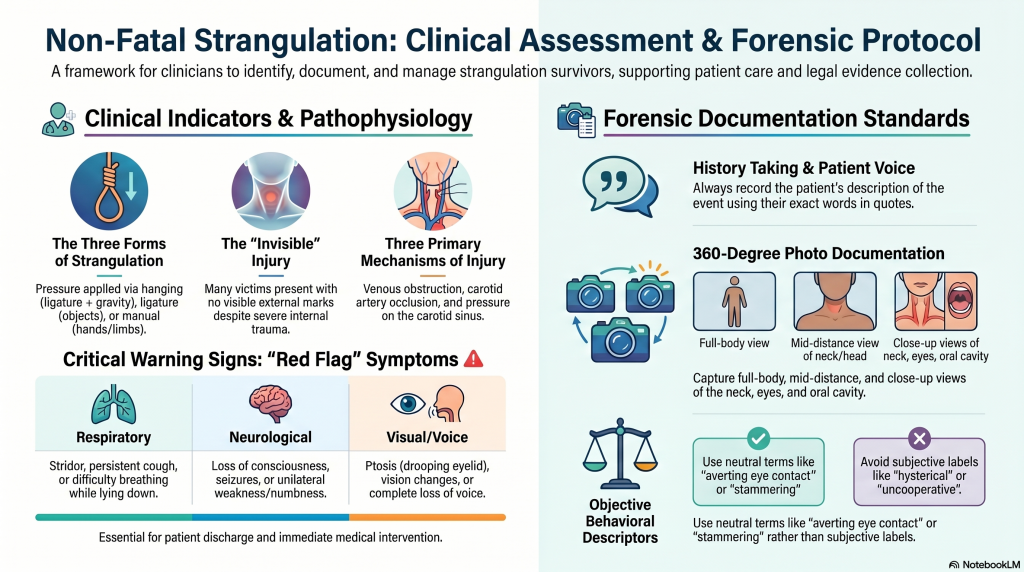
The Clinical Pathology of Non-Fatal Asphyxiation
- Airway Compression (Lungs): Requires immense structural physical force to collapse cartilaginous rings.
- Carotid Artery Compression (Brain): Requires far less physical force. It immediately blocks oxygenated blood supply directly to the cerebral cortex, causing rapid, profound cellular hypoxia.
The ‘Invisible’ Trauma: Hypoxia and Traumatic Brain Injury (TBI)
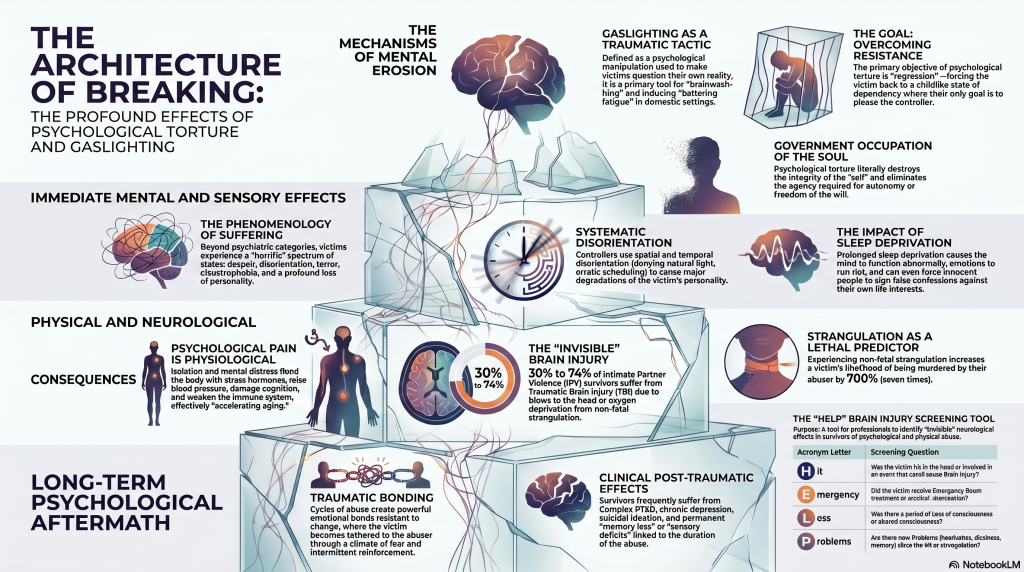
30–74% of IPV victims seeking emergency or community assistance suffer from functional, undiagnosed Traumatic Brain Injury (TBI), leading to permanent cognitive deficits, severe unmanaged anxiety, and treatment-resistant PTSD.
Mental Torture: Clinical Reality vs. U.S. Law
| Neurobiological & Clinical Reality | U.S. Legal Code Erasures |
|---|---|
| Physiological Brain Assault: Science views psychological torture as an anchored, physiological assault on the brain architecture. | The Materialist Bias: Statutory frameworks treat physical pain as ‘real’ and documentable, while treating profound mental pain as suspicious or secondary. |
| Profound Resulting States: Clinical reality defines mental torture explicitly by the profound resulting experience (chronic despair, structural PTSD). | The Substitution Trick: Federal law strictly restricts mental torture definitions to four specific narrow causes (e.g., imminent death threats, drugs). |
| Personality Destruction: Clinical gravamen focuses directly on the merciless, sustained attempt to break down the operational personality. | The Forensic Fallacy: Law regularly confuses the due process need for specific operational definitions with the actual psychological nature of the crime. |
| Information Extraction: Perpetrators utilize structured psychological torture explicitly for long-term control and strategic information extraction. | The Mens Rea Requirement: U.S. law mandates the perpetrator must specifically intend to cause prolonged mental harm—effectively exonerating all but pure sadists. |
Resisting Simple Dichotomies in Rape Law
Views rape fundamentally as a baseline violation of bodily autonomy and individual choice.
Focuses structurally on physical force and property rights over the human body.
Views rape as a broader systematic expression of patriarchal dominance and heteronormativity.
Focuses heavily on systemic male power structures and female subjugation.
- Alienates complex realities and male victims.
- Ignores strategic survivor behaviors.
- Traumatizes survivors by insisting they remain helpless.
Intersectional Models & Restorative Justice
The Biological Toll: PTSD & The Endocannabinoid System (ECS)
Chronic trauma exposure profoundly dysregulates the HPA axis, resulting in an over-active, hyper-responsive amygdala and deficient prefrontal cortical regulation.
Severe, unremitting trauma fundamentally depletes circulating endogenous cannabinoid levels in the central nervous system.
The Consequence: This physiological depletion traps the brain in an unyielding loop, rendering it physically incapable of running normal fear extinction conditioning. The brain completely fails to separate current safety parameters from past terror.
Cannabinoids as Interventions: Mechanisms of Action
Efficacy of Medical Cannabis & Clinical Trials for PTSD
Participants using monitored whole-plant cannabis were 2.57 times more likely to no longer meet DSM-5 clinical criteria for PTSD at the end of a 1-year prospective observational period compared to non-using controls.
Whole-Plant vs. Synthetics: Unlike isolated synthetic molecules, whole-plant, full-spectrum cannabis produced significant improvements in global symptom severity.
Target Symptom Resolution: Clinical trials confirm dramatic enhancement in subjective sleep quality, a marked decrease in distressing nightmare frequency, and a sustained reduction in daytime hyperarousal.
Allowing patients to self-titrate (ad libitum dosing) accounts perfectly for wide individual variability in cannabinoid receptor tolerability.
Synthesis Arc: The Multidisciplinary Healing Model
The Clinical-Forensic Blueprint of Severe Poly-Trauma
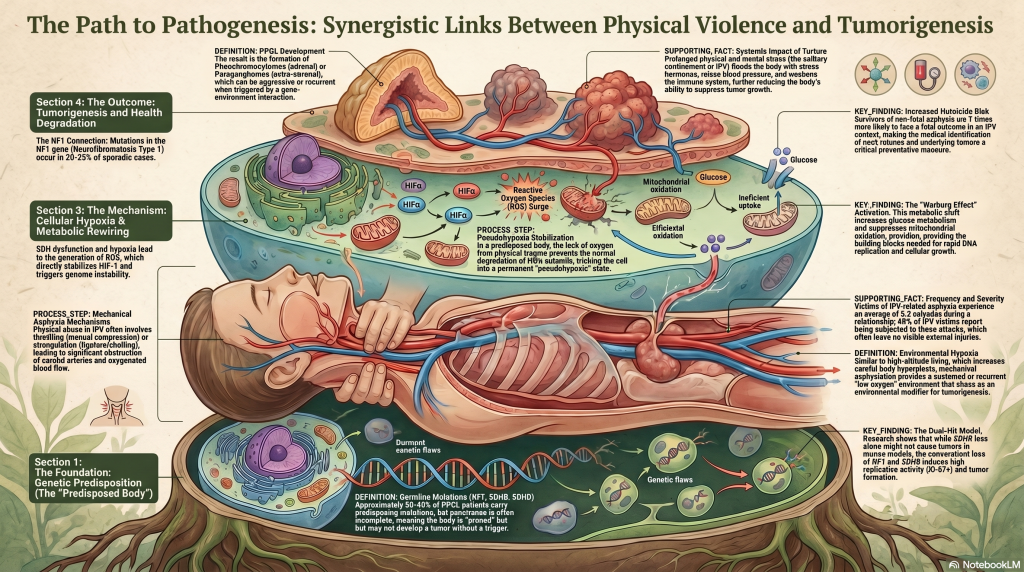
Integrating Carotid Neoplasia, Baroreflex Failure, and Adrenergic-Driven Malignancy in Survivors of Severe Exploitation.
• CAROTID BIFURCATION: STABLE STRUCTURAL MARKER
The Physics of Immobilized Strangulation
Flightless immobilization places anterior neck fascia under extreme tension. This pulls the carotid sheath forward, stripping away natural muscular buffering.
Trauma-Induced Pseudohypoxia vs. Normoxia
Normoxia
Trauma-Induced Pseudohypoxia
The Paradox of the Fibrotic Niche
“Repetitive mechanical contusion paradoxically protects against systemic malignancy.”
Microscopic Field of View mechanics structurally lock cellular instability within localized parameters rather than allowing escape.
- Continuous Upregulation of VEGF: Forces the tumor to constantly remodel its local vascular bed rather than escape.
- Fibrotic Encasement: Mechanical irritation locks the tumor within a reactive tissue-repair niche, preventing endothelial-to-mesenchymal transition.
- Arrested Deletions: Structural constraint prevents H3K27me3-retentive genomic instability required for true metastasis.
Severing the Autonomic Arc
Repeated manual strangulation and contusions physically destroy and fibrose the mechanosensitive stretch receptors in the carotid sinus adventitia.
The Autonomic Shift Matrix
| Parameter | Normal Baroreflex Function | Post-Traumatic Afferent Baroreflex Failure |
|---|---|---|
| Systemic Hemodynamics | Buffered within narrow limits (120/80 mm Hg). | Labile and volatile, swinging from <90/50 to >250/150 mm Hg. |
| Circulating Catecholamines | Steady norepinephrine (<300 pg/mL). | Pathological storms (>1000 to 2000 pg/mL). |
| State-Dependent Response | Buffers stressors easily. | Minor stressors trigger unregulated sympathetic surges; rest triggers profound hypotensive valleys. |
| Cardiovascular Risk | Low risk profile. | Extreme risk of myocardial infarction, aortic dissection, and hemorrhagic stroke due to severe endothelial shear stress. |
The Trauma Feedback Loop
Causes continuous massive Catecholamine Storms (Adrenaline/Norepinephrine). Unregulated sympathetic outflow leads to systemic deluge.
Adrenaline continuously binds to beta-2-adrenergic receptors (ADRB2) on Schwann cells. Constant activation of G-protein coupled receptors.
ADRB2 activation suppresses Hippo pathway -> YAP/TAZ translocate to the nucleus. Co-activators are freed to enter the nucleus.
YAP/TAZ binding expands CD133-positive cancer stem cells, driving a Malignant Peripheral Nerve Sheath Tumor (MPNST) highly aggressive sarcoma.
The Autocrine Loop Center
MPNST dedifferentiates, acquiring catecholamine synthases (Tyrosine Hydroxylase, DDC, DBH, PNMT) to synthesize its own microenvironmental adrenaline, self-feeding its own lethal growth.
Craniofacial Biodynamics and Hydraulic Entrapment
High-Velocity Gestational Shearing
- By 20 weeks, the uterus rises out of the protective bony pelvis, fully exposed to anterior impacts.
- During sudden deceleration, the maternal abdominal wall impacts a hard surface, generating a massive intra-abdominal pressure spike.
- The Shearing Mechanism: The uterine wall is highly elastic (ELASTIC), but the placenta is inelastic (INELASTIC). Violent deceleration tears the decidua-placental interface, causing acute placental abruption and fetal hypoxia.
Post-Traumatic Adhesions: Asherman’s Syndrome
The Physical Reality of Invisible Brain Injury
The Mechanisms of Mental Erosion
- Gaslighting as a Traumatic Tactic: Psychological manipulation used to make victims question reality. Primary tool for “brainwashing” and inducing “battering fatigue”.
- Systematic Disorientation: Controllers use spatial and temporal disorientation (denying natural light, etc.) to enforce major degradations of personality.
- Traumatic Bonding: Cycles of abuse create powerful emotional bonds resistant to change, tethering the victim to the abuser through fear and intermittent reinforcement.
The HELP Screening Tool
(H)it in the head, (E)mergency room treatment, (L)oss of consciousness, (P)roblems since the event (memory/dizziness).
The Medico-Legal Paradox Table
| Parameter | Clinical Sign | Legal Reality / Resolution |
|---|---|---|
| Strangulation & Lethality | Often no visible bruising (80%). | Meets attempted manslaughter criteria; increases subsequent homicide risk by 750%. |
| Coercion & Consent | Branding tattoos, untreated STIs, recurrent trauma. | Establishes a “climate of fear” under TVPA, invalidating legal consent. |
| Victim-Offender Intersectionality | Paradox: Victims are often unjustly prosecuted for secondary crimes. | Resolution: Clinical affidavits proving life-threatening duress eliminate mens rea (criminal intent). |
| Compulsory Reporting | Dilemma: Mandatory reporting laws vs. immediate risk of retaliatory violence. | Resolution: Trauma-Informed Care must precede statutory reporting to ensure physical safety. |
Trauma-Informed Care (TIC) Protocol: SOAR
Become familiar with the nature and types of human trafficking and poly-victimization.
Identify non-verbal indicators: Is someone speaking for them? Restricted movements? Untreated trauma indicators (TBI, branding)?
Screen using a trauma-informed approach. Assess emotional safety before physical data collection.
Emotional Safety Check Trauma ScreeningSecure culturally sensitive resources (IHS, Tribal, Urban Indian centers) before initiating mandatory reporting to prevent retaliatory violence.
Multidisciplinary Clinical Reconstruction Architecture (Traumatized Patient)
The Critical Imperative Hierarchy
Supporting historical trauma recovery and long-term consequences across the lifespan.
Expanding IHS Medical Forensic Examinations, SANE/FNE nursing access, and Multidisciplinary Team (MDT) rapid responses.
Engaging healthy community conversations, strengthening food/housing security, and expanding Native culture/language education.
Statistical Reality Matrix
40% of women involved in sex trafficking are identified as AI/AN, and 84.3% of AI/AN women will experience violence in their lifetime.
Culturally-competent forensic healthcare is the frontline defense.
INFOGRAPHICS